Amongst the various uncertainties I wrestled with this week, the least concerning was my son repeatedly driving past (and not hitting) the nativity scene in the parking lot of the Catholic school in which he practices parking. Circling the parking lot for an hour with my son (avoiding the Baby Jesus, a goat, and the wise men) was a good distraction from my anxieties about Omicron, travel, and holiday gatherings. We are still about a few weeks away from a sharper picture of the pandemic's next stage.
---- Latest Data
Cases, hospitalizations, and death rates are trending up again.
https://www.nytimes.com/interactive/2021/us/covid-cases.html
and
Country Comparison from FT.com
The CDC Weekly Review of Data and Variant Tracking discussed the safety of vaccines in pregnancy (it is safe!).
https://www.cdc.gov/coronavirus/2019-ncov/covid-data/covidview/index.html
And, despite omicron discussion, as of the week of 11/29, Delta is still the most common variant in the United States
https://covid.cdc.gov/covid-data-tracker/#variant-proportions
The NY Times offers an Omicron information page that is very comprehensive.
https://www.nytimes.com/interactive/2021/health/coronavirus-variant-tracker.html
The Atlantic published a long-form interview with virologist Dr. Boghuma Kabisen Titanji from Emory.
https://www.theatlantic.com/science/archive/2021/11/omicron-coronavirus-variant-what-we-know/620827/
John Burn-Murdoch (data visualizer for the Financial Times) shared this excellent data analysis on Omicron from South Africa as of day 20+ since identifying the variant. OUR UNDERSTANDING IS EVOLVING. PLEASE TAKE THIS INFORMATION AS A PRELIMINARY SNAPSHOT AT THIS MOMENT IN TIME (and likely to change).
Takeaways:
https://twitter.com/jburnmurdoch/status/1467270450111787012
Omicron is highly transmissible and offers some degree of vaccine escape. Here is some modeling of an Omicron wave if Omicron's effective transmission rates (Rt) are between 3.0 and 4.0. Of note, in South Africa, the Rt is currently 3.6. But this number will be more precise in time.
https://twitter.com/JPWeiland/status/1467252861104967681
(If you need a reminder on effective transmission, here is a quick overview from Spring 2020
https://www.weforum.org/agenda/2020/05/covid-19-what-is-the-r-number/)
In the coming weeks, it will be critical to:
The Lancet published a large cohort study from the UK on the safety of booster doses of COVID vaccines. This data reinforces that boosters are safe.
https://www.thelancet.com/journals/lancet/article/PIIS0140-6736(21)02717-3/fulltext
Some children under 18 may soon be eligible for boosters.
Here is an excellent 10 min TED talk on how mRNA vaccines work from Kathryn Whitehead, a biomedical engineer from Carnegie Mellon.
The mRNA vaccines have five ingredients, and she details all of them. Guess what? None of the ingredients are nanobots.
https://www.youtube.com/watch?v=O16Pfv6nd7M
And just in time for Christmas, the NY Times released its N95 mask review and shopping guide. Tell me, who amongst us would not want to wake up to a box of well-tested N95 masks on Christmas morning?
https://www.nytimes.com/wirecutter/reviews/where-to-buy-n95-kn95-masks-online/
I will share this Twitter discussion to highlight the missed opportunity to market vaccines based on the potential for erectile dysfunction as a complication from being infected with COVID.
https://twitter.com/AshleyGWinter/status/1466817461798391812
Infographics
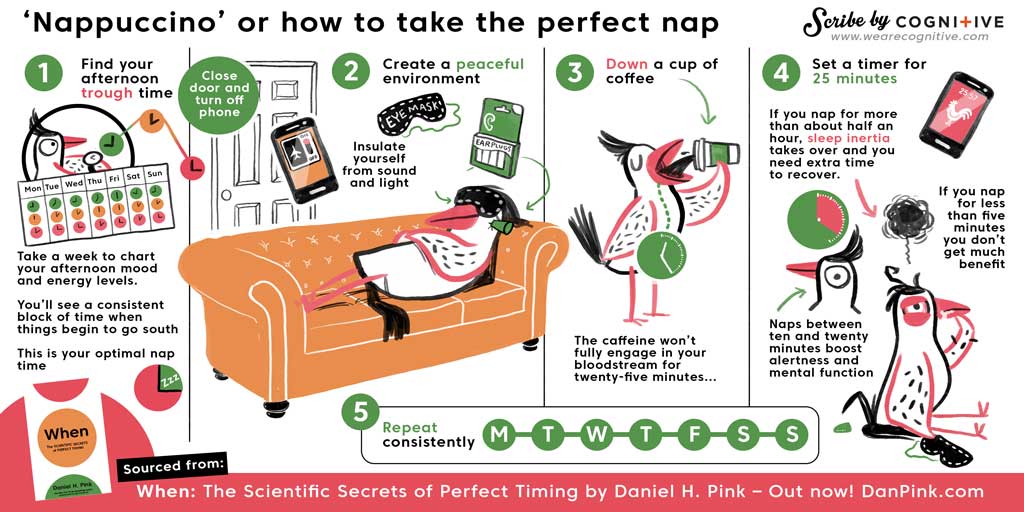
Daniel Pink's Nappucino was a thing in my life this past week.
https://www.danpink.com/wp-content/uploads/2018/07/NAPACCINO_FINAL.jpg
from
https://www.danpink.com/resource/when-napaccino/
Things I learned this week
You can make a hypersonic trebuchet at home. I'm sure your neighbors will be equally excited about the project as you - unless you are laying siege to your neighbor's house.
In 1790, Catherine the Great was pro-vaccine. And getting vaccinated against smallpox in 1790 had a much different risk/reward calculation.
https://www.nytimes.com/2021/11/29/arts/catherine-the-great-vaccination-letter-auction.html
From a 2014 article out of the Georgia Institute of Technology - Irrespective of a mammal's mass and bladder size, urination time is consistent across many species. "Using high-speed videography and flow-rate measurement obtained at Zoo Atlanta, we discover that all mammals above 3 kg in weight empty their bladders over nearly constant duration of 21 ± 13 s. This feat is possible, because larger animals have longer urethras and thus, higher gravitational force and higher flow speed." Now you know. (And knowing is half the battle!). The slow-motion video is well worth the click.
https://www.pnas.org/content/111/33/11932
Thank you, Dr. Winter
https://twitter.com/AshleyGWinter/status/1467548234490912775
My kids are in the midst of SAT/PSAT season. They have started mentioning some of the reading passages that stuck with them. My favorite is peer-reviewed research from Japan demonstrating that viewing cute images (Kawaii) promotes more careful behavior and improves focus. We should be lining the walls of offices with baby animal pictures.
https://journals.plos.org/plosone/article?id=10.1371/journal.pone.0046362
Similar to hugging research from last week, Japanese social psychologists are actively publishing on the topic of Kawaii.
https://pubmed.ncbi.nlm.nih.gov/?linkname=pubmed_pubmed&from_uid=23050022
Some highlights
Viewing cute pictures may improve performance during basketball free throws.
https://pubmed.ncbi.nlm.nih.gov/33981267/
But, cute images can spawn "cute aggression." I now believe this to be the source of the often stated, "The baby is so cute I could just eat them," you hear from creepy relatives.
https://pubmed.ncbi.nlm.nih.gov/30564109/
Clean hands and sharp minds,
Adam