Fugitive sheets were printed broadsides sold to medical students and the curious in the 1500s: a standing anatomical figure with layered paper flaps you lifted to see the organs underneath. They were cheap, they were popular, and almost none of them survive, because the flaps were handled until they fell off. Hence the name.
The form fits the week. Every story in this issue is about something concealed inside a body and whether anyone lifts the flap: chronic viruses transcribing away in people nobody thought to test, a kidney quietly rewriting blood chemistry at altitude, inner speech decoded from a motor cortex that never agreed to it, and a gene-therapy trial whose central fact stayed sealed for sixteen months. So there are three flaps lifted here, and a fourth sewn shut with red thread and a wax seal, showing nothing.
Reading the sheet
- Cranium, padlocked. The mental keyword that locks and unlocks an inner-speech decoder.
- Chest flap, lifted. Dormant virions nested among the organs like ornamental seeds.
- Abdomen flap, lifted. Oversized kidneys against a mountain range, with a stream of glyphs pouring out. Altitude and bicarbonate.
- Lower left flap, sealed. Sewn with red thread, wax seal, not lifted. The disclosure nobody made.
- Margins. Sea pig, skeleton panda sea squirt, harvestman, marmot with a blank placard, red-lipped batfish, an ornamental virion, a magnetoencephalograph as Renaissance helm, and a tunicate larva with its notochord picked out in red.
- Corners. A ship with a bicycle lashed to the mast, and two identical old men separated by a rule with a different year on each side. The Welsh birthday cutoff.
The three renderings
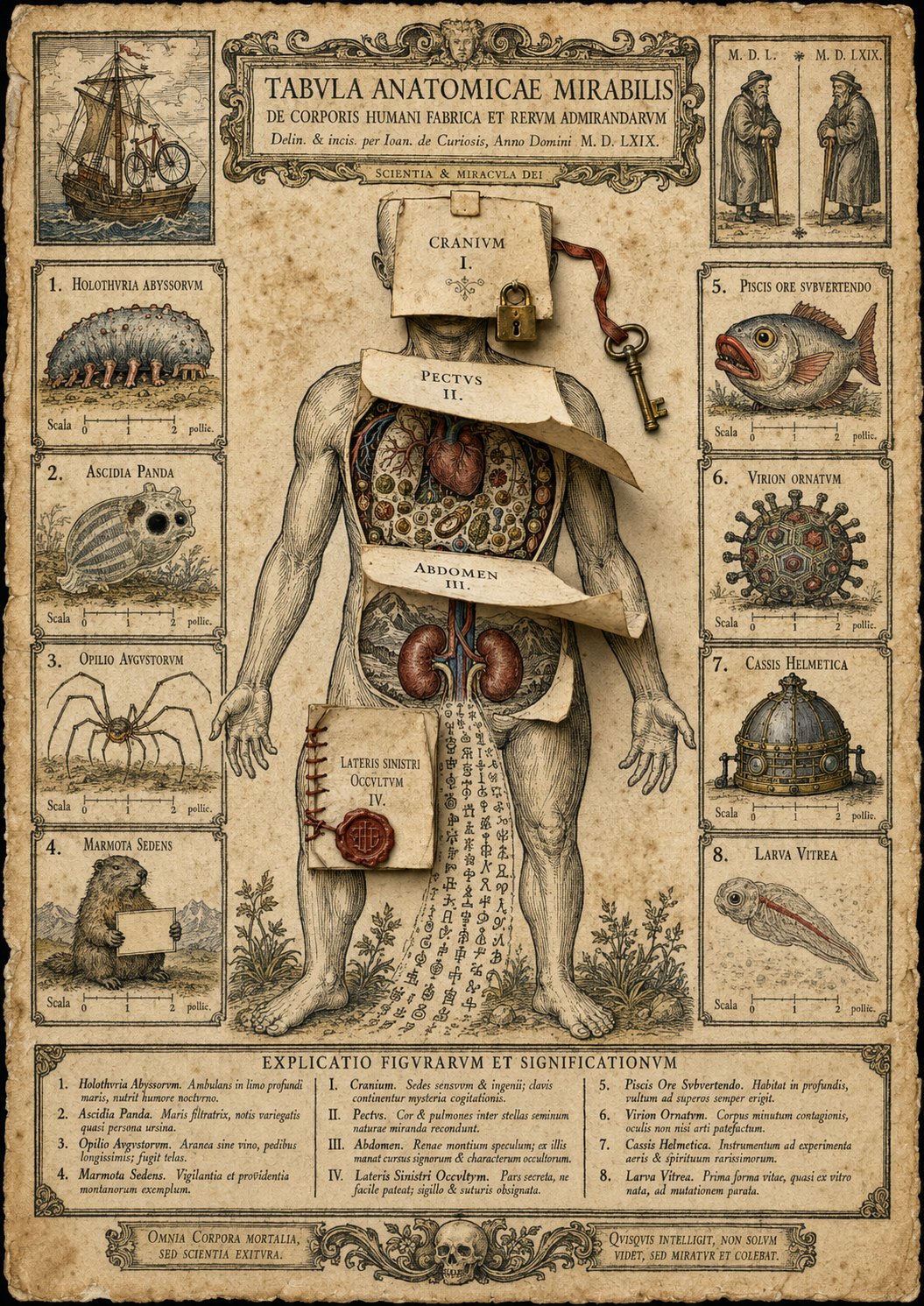
The only one that numbered all four flaps and made the sealed one a labeled part of the anatomy rather than an afterthought: LATERIS SINISTRI OCCVLTVM IV, red thread, wax seal, nothing beneath. It invented an engraver (Ioan. de Curiosis), a coherent key block, and two mottoes at the base about knowledge outliving the body. The kidney entry reads "renae montium speculum," kidneys as a mirror of mountains, which is a better line than anything I wrote this week.
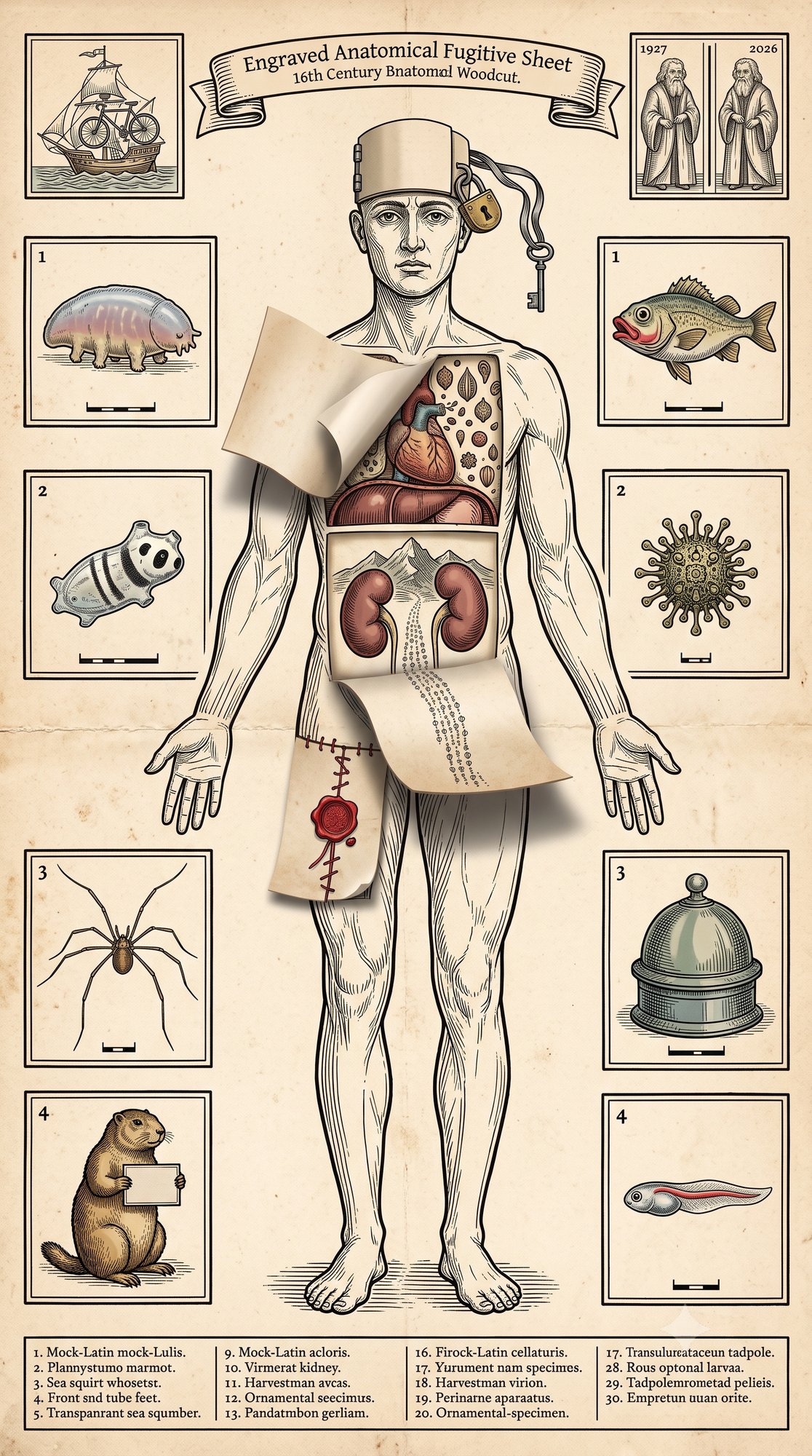
Best paper, worst text. The flaps genuinely curl and cast shadows, which is the hard part and the whole point of the format. Then it titled the piece "Engraved Anatomical Fugitive Sheet, 16th Century Bnatomol Woodcut," which is a model reading its own instructions aloud and misspelling them. The key block decays into thirty lines of English mush, the specimen boxes are numbered 1 through 4 twice, and the two old men are dated 1927 and 2026 instead of in Roman numerals. Also the harvestman has two body segments, which makes it a spider.
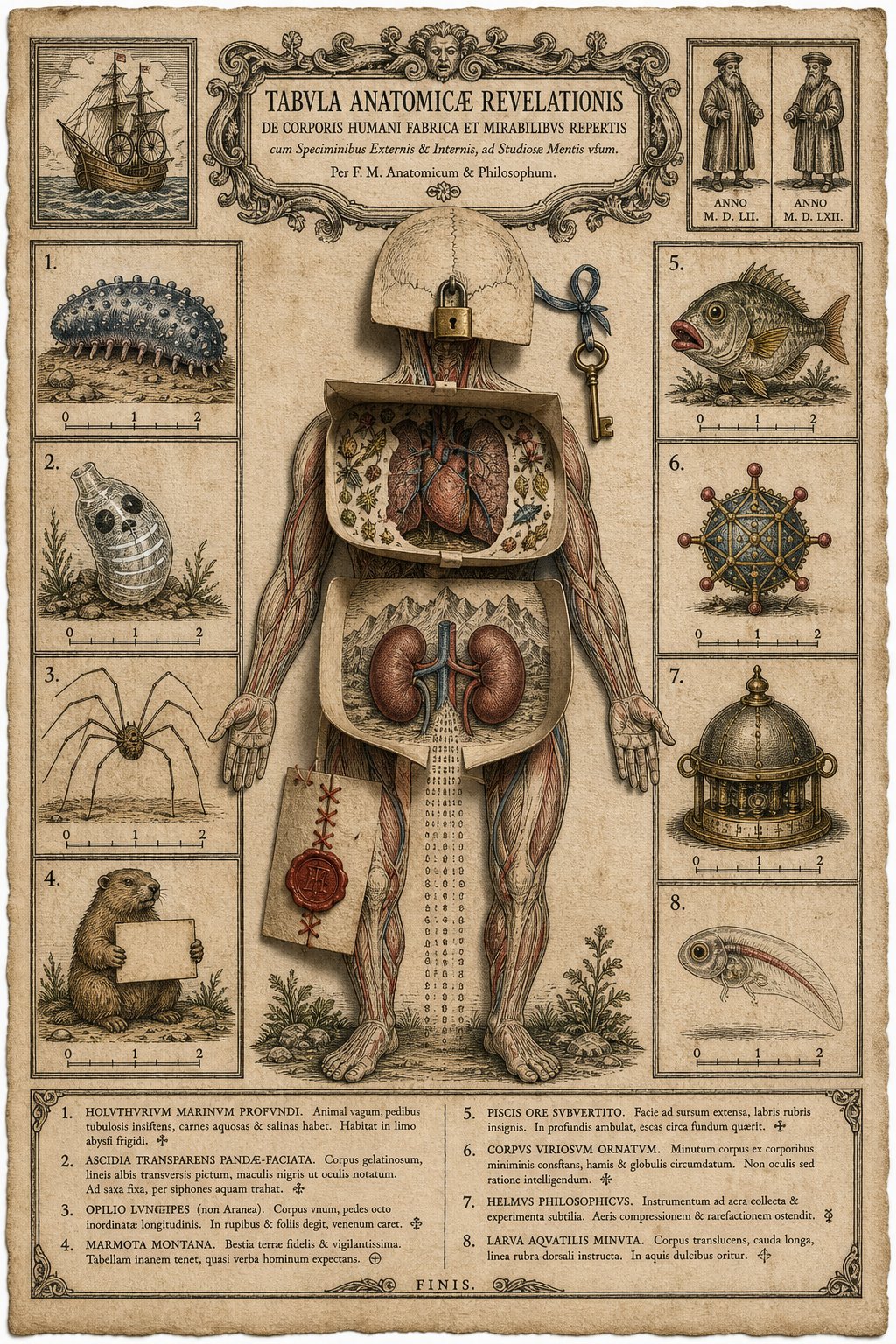
The best engraving of the three, and the only one that took the correction seriously. Its harvestman is captioned OPILIO LVNGIPES (non Aranea): longlegs, not a spider. The marmot entry says it holds a blank tablet as if awaiting the words of men, which is a funnier caption for an OnlyFans joke than an OnlyFans joke. The kidney glyphs come out as a column of binary. The one loss is the sealed flap, which floats beside the figure rather than sitting on the body, so it reads as a document rather than as something withheld from you.
The prompt
A 16th-century anatomical fugitive sheet, single large broadside, hand-tinted woodcut on aged laid paper with visible chain lines and foxing. Central standing anatomical figure, arms slightly away from the body, rendered in fine black woodcut outline with muted hand-coloring in ochre, oxblood, sage, and Prussian blue.

Three layered paper flaps over the figure's body, each shown partially lifted and curling forward with soft cast shadows and visible paper tabs, in the manner of a museum photograph of a working flap print. The uppermost chest flap is lifted to reveal, among the organs, a scattering of small ornamental seed-like forms rendered as specimens. A second flap over the abdomen is lifted to reveal two oversized kidneys, with a small engraved mountain range behind them and a fine stream of tiny glyphs flowing downward from the kidneys. A hinged flap over the cranium is closed and secured with a small brass padlock, a key hanging from a ribbon beside it.

A fourth flap over the lower left torso is sewn shut with red thread and sealed with red wax. It is not lifted and nothing is visible beneath it.

Flanking the central figure, two vertical columns of four small framed specimen vignettes each, in the same woodcut manner, each with a number and a scale bar: a plump translucent deep-sea sea cucumber walking on stubby tube feet; a small transparent sea squirt whose front end bears white transverse bands and dark pigment spots resembling a panda mask; a harvestman arachnid with a single oval body and eight very long thin legs, not a spider; a seated marmot holding a small blank placard; a fish with an upturned face and prominent red lips; an ornamental virion specimen; a large domed scientific apparatus resembling a Renaissance helm; and a tiny translucent tadpole-like larva with a red line running down its back.

Upper corners: a small vignette of a sailing ship with a bicycle lashed to its mast; and a vignette of two identical elderly figures separated by a vertical rule, a different date engraved on each side.

Engraved banner title across the top and a letterpress key block of numbered mock-Latin entries across the base. Overall: scholarly, symmetrical, densely populated, printed-broadside authority. No modern elements, no photographic realism.
Per-platform notes
- ChatGPT / DALL·E. Handles the lifted-flap shadow best. Add: "the flaps must read as separate sheets of paper physically lifted off the figure, with visible edges and shadow."
- Gemini. Best at the dense margin grid, but specify "eight small framed panels, four on the left and four on the right, evenly spaced" or they scatter. Request 3:4 portrait.
- Midjourney. Append
--ar 3:4 --style raw --s 150and cut the last two paragraphs; it degrades past roughly sixty words of scene description. - Perplexity / Grok. Give the first three paragraphs only and drop the corner vignettes, or the specimen columns disappear.
- All four. Do not fight the Latin. Every model produces plausible nonsense, which is exactly what a real fugitive sheet looks like to a modern reader anyway.
One prompt, three models, no post-processing beyond JPEG conversion. Style reference: printed anatomical flap sheets of the 1500s and 1600s, the ephemeral cousins of Vesalius. Style not previously used in this newsletter; see the running roster in the openings and art log. wair.ajwein.com · the full archive