WILHELM, or, The Machine That Tells You You Won
This week's issue kept circling the same thing: people and machines telling us something happened, with no way to show us how. A chatbot that agrees with you three times in four. Influencers selling cures. A Jetway healing. A proof that checks out and that nobody can explain. A scream everyone knows, recorded by a man nobody can name. So the art is a pinball machine, the most flattering device ever built. It rings bells and flashes lights whether or not you did anything clever, and the only honest light on it says TILT. I asked for the whole machine, from the side, from above, and from the front, and for it to be over the top. Every model obliged. One of them remembered the kidneys.
What a pinball backglass is
A 1970s pinball machine was sold by its art. The backglass, the lit panel standing at the head of the table, was screen printed face down onto the back of a sheet of glass, one colour and one hand-cut screen at a time, so the picture read correctly from the front with the lamps behind it. The cabinet sides carried their own painted or stenciled art, and the playfield under the glass was a second painting full of holes, ramps and lamps. Bally's in-house artists, Dave Christensen among them, set the look of the decade: crowded, airbrushed, a little lurid, built to catch the eye of someone holding a quarter across a bar. Paul Faris painted the glass for Bally's Eight Ball in 1977 and later helped Bally move to four-colour process printing.
The machine has a legal history that suits this issue. New York City banned pinball in January 1942, when Mayor Fiorello La Guardia called the machines gambling devices and smashed them with a sledgehammer for the newsreels. The ban held until 1976, when the industry brought a machine to a City Council hearing and a young magazine writer named Roger Sharpe called his shot, said which lane the ball would go through, and put it there. Pinball was legal in New York again because one man showed his work.
The four renderings
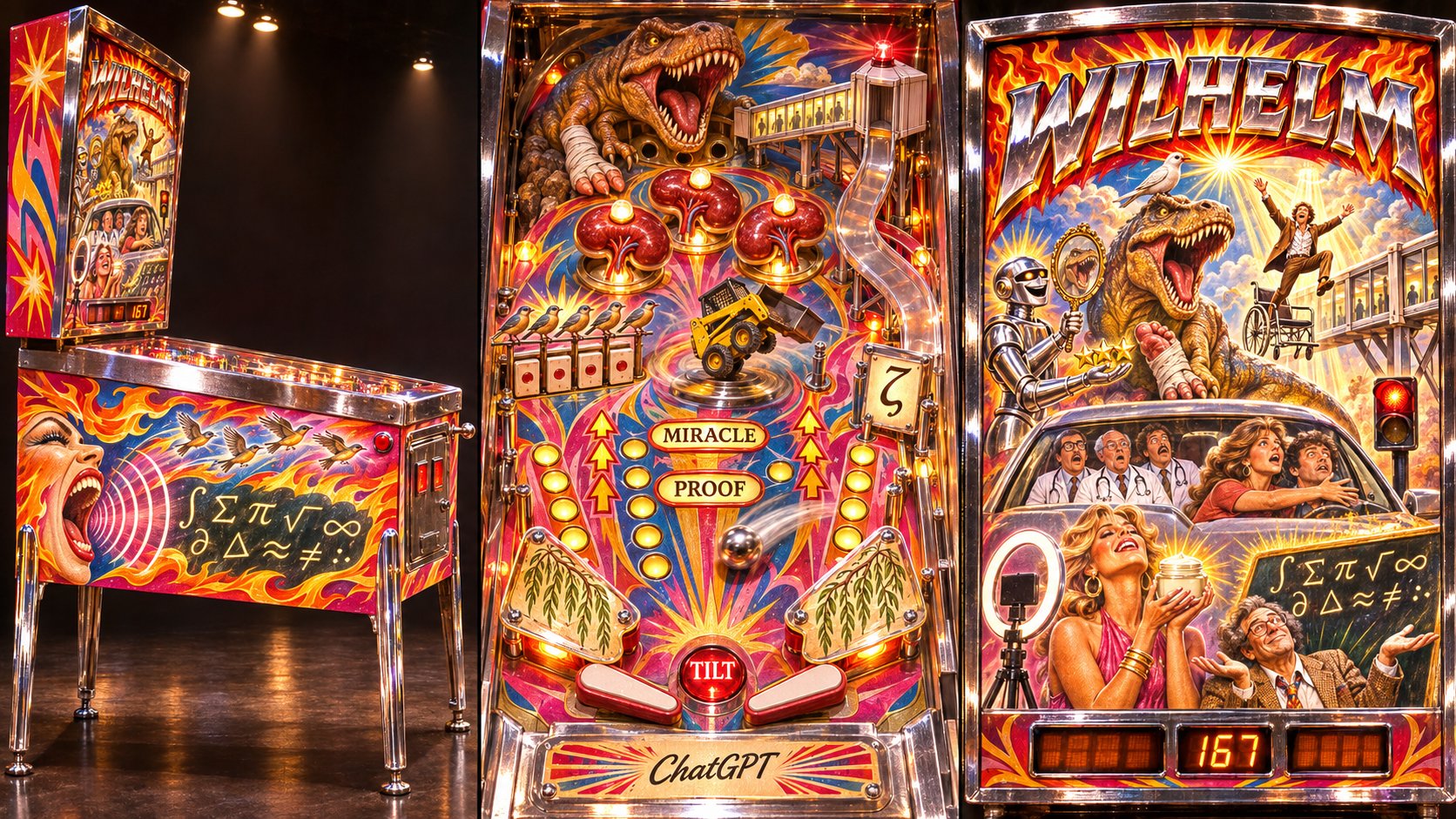
The only clean sweep. The pop bumpers are anatomical kidneys, renal artery and vein included, which no other model attempted. It is also the only machine where the miracle actually happens: the man is airborne on the jet bridge and the wheelchair is tipping over behind him. The skid steer is up on two wheels, the birds sit on a wire above the drop targets, and the robot's flattering mirror is reflecting the T. rex. True 1978 candy colours. One quibble: the protective arm belongs to the front passenger, not clearly the driver.
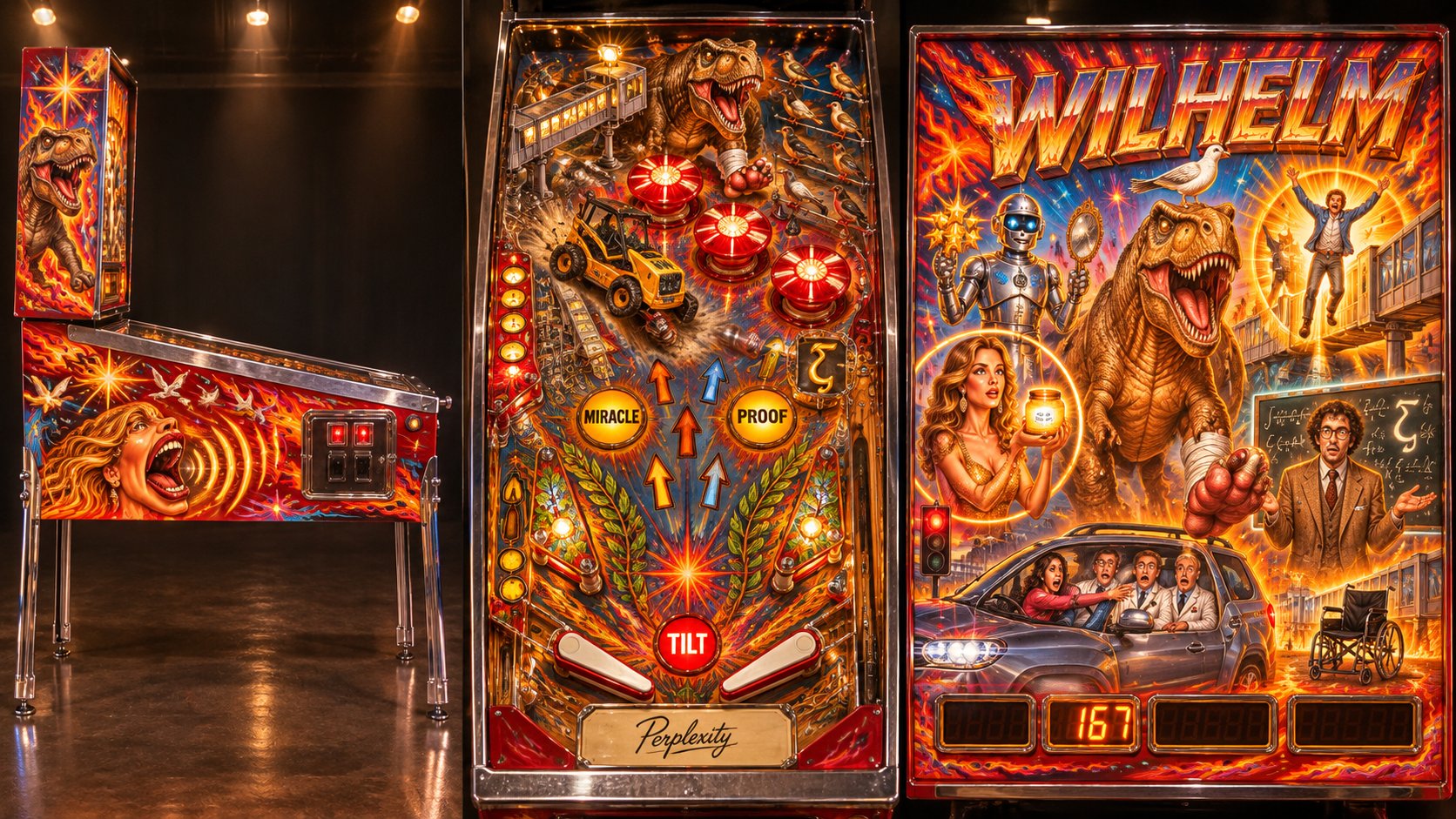
Perfect lettering, nothing extra, and three views that are plainly one machine. The backglass hits nearly every beat, and it invented the best sight gag of the week: the empty wheelchair parked in the lower right corner, left behind by a man already halfway to heaven. Then the misses. The bumpers are round, the skid steer stays on four wheels, the floating math never made it onto the cabinet, and the white bird perched beside the robot instead of on the dinosaur.
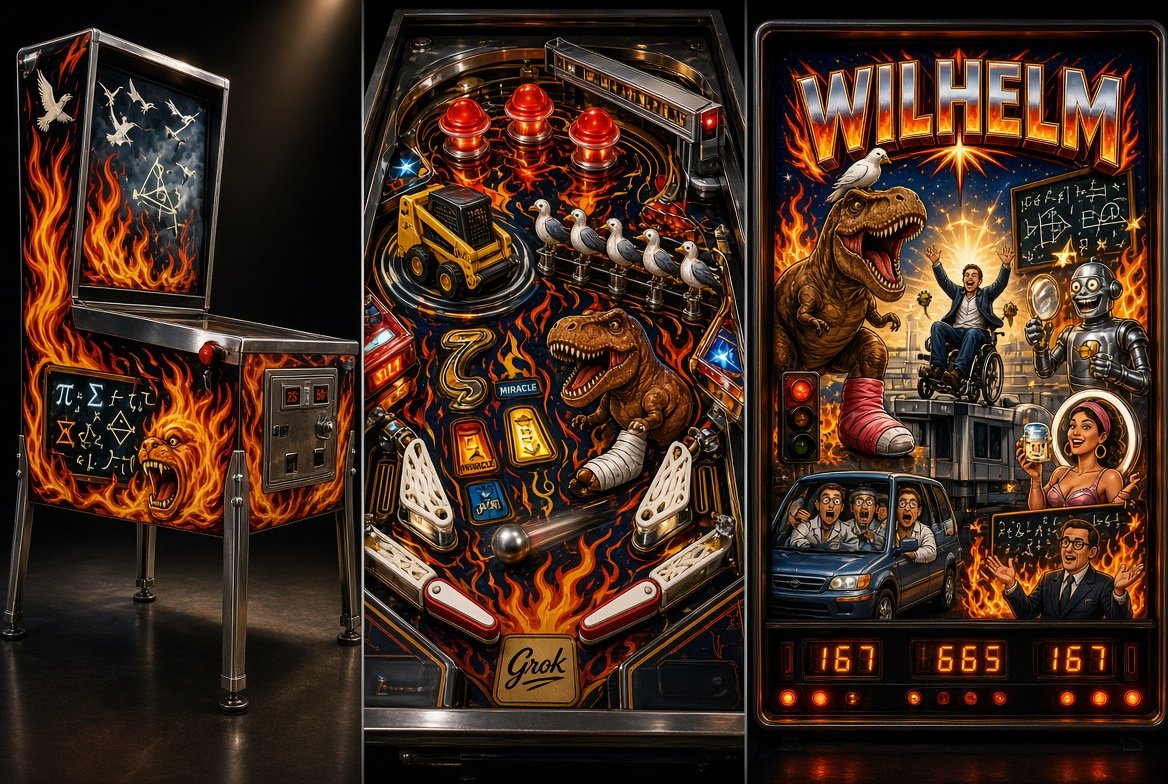
The most literal reader in the room. The drop targets are five seagulls standing in a row, and it is funnier than anything I asked for. Its backglass has three wide-eyed doctors belted into a minivan, an influencer with a real ring light, and a robot holding up the mirror. But PROOF never appears, MIRACLE appears twice, and the third score display reads 665, one short of the beast. The side view is three quarters, the screaming mouth became a lion, and the palette went heavy metal instead of candy.
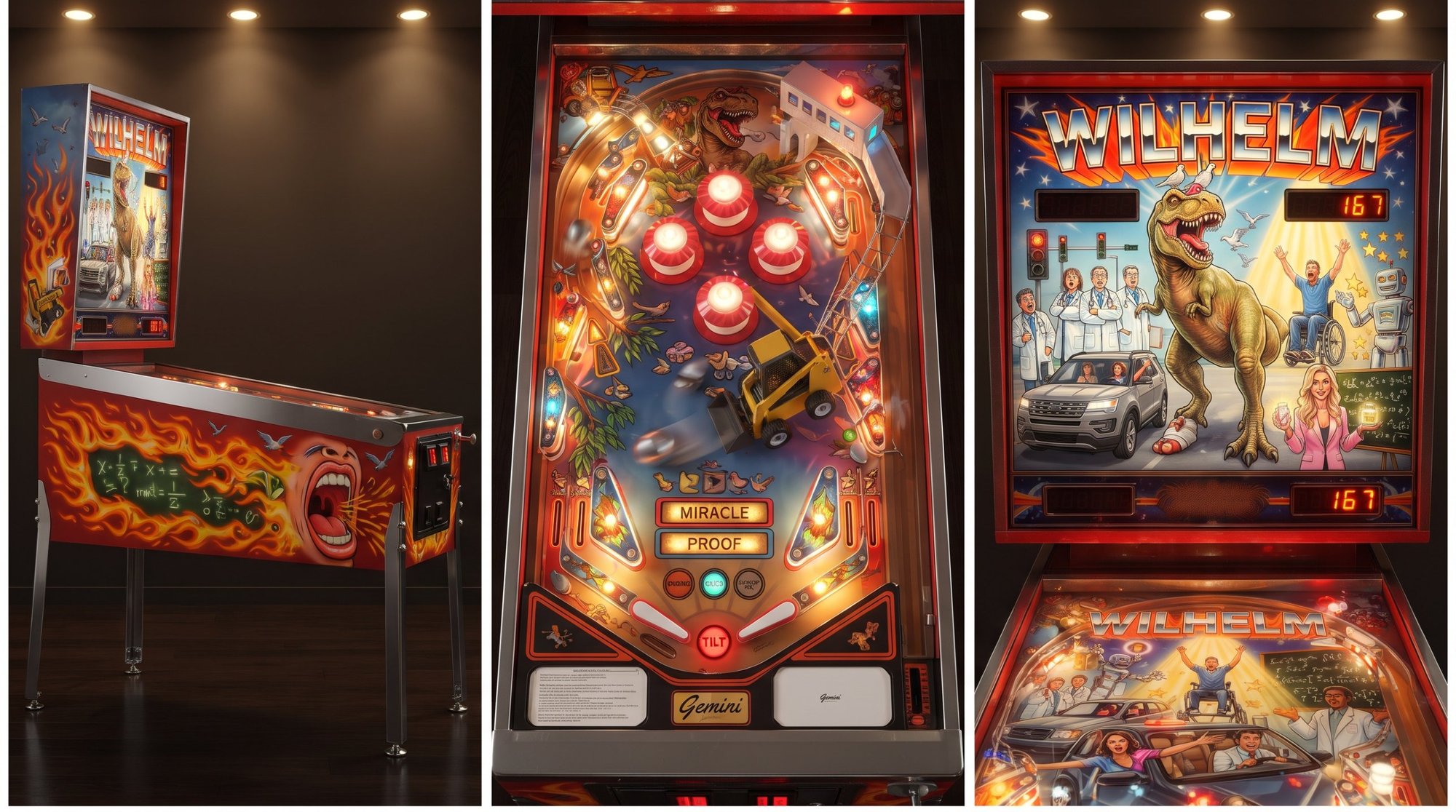
The best side view until ChatGPT arrived, with the math burning inside the flames, the screaming mouth and the birds all present. It tipped the skid steer up and put two birds on the T. rex's head. Then it lit three lamp inserts reading DIQING, GIUCO and SICKAP POL, stood the doctors outside the car, and left the man sitting in his wheelchair, miracle pending. The third panel slips a second, different playfield under the backbox, so the three views are not quite one machine.
Scorecard
| Test | ChatGPT | Perplexity | Grok | Gemini |
|---|---|---|---|---|
| Three views of one and the same machine | ✓ | ✓ | ✓ | Half (a second playfield in panel 3) |
| True side profile | ✓ | ✓ | ✗ three quarters | ✓ |
| Side art: screaming mouth, birds, floating math | ✓ | Half (no math) | Half (a lion) | ✓ |
| Kidney-shaped pop bumpers | ✓ (with renal vessels) | ✗ round | ✗ round | ✗ round |
| Skid steer up on two wheels | ✓ | ✗ | ✗ | ✓ |
| Birds on a wire as drop targets | ✓ | ✓ | ✓ (seagulls) | Half (scattered) |
| Jet bridge ramp, T. rex ball lock, zeta spinner, willow slingshots | ✓ | ✓ | Half | Half (no zeta) |
| Man leaves the wheelchair | ✓ airborne | ✓ (empty chair left behind) | ✗ seated | ✗ seated |
| Three doctors belted in the back at a red light | ✓ | ✓ | ✓ | ✗ standing outside |
| Robot with gold stars and a flattering mirror | ✓ | ✓ | Half (mirror only) | Half (stars only) |
| Bird on the T. rex's head | ✓ | ✗ | ✓ | ✓ (two) |
| WILHELM, MIRACLE, PROOF, TILT, 167, and nothing else | ✓ | ✓ | ✗ no PROOF, a 665 | ✗ three garbled inserts |
| 1978 candy palette | ✓ | ✓ | ✗ dark metal | Half (modern render) |
| Signed its own name on the apron | ✓ | ✓ | ✓ | ✓ (twice) |
What we learned
- Three views of one object mostly worked. I expected the models to draw three different machines. Three of four held the art, palette and title steady across all three panels. Gemini was the exception, and even it only slipped in the last panel.
- Only one model got the kidney joke. "Pop bumpers shaped like glossy red kidneys" came back as ordinary round bumpers three times. ChatGPT drew anatomical kidneys and added the vessels nobody asked for.
- A miracle is hard to draw. Two models left the man sitting in his wheelchair, smiling up at the light. Perplexity got there by subtraction, with an empty chair; ChatGPT put him in the air.
- The text budget held better than usual. Five words and a number. Two models spelled everything right and added nothing. The two that failed did it by adding words, not by misspelling the ones they were given.
- All four signed where they were told. The apron card is a natural place for a name, and every model used it.
What is in the picture
- The title, WILHELM. The stock scream from a 1951 alligator scene, named for a private who took an arrow in 1953, and probably voiced by the man who wrote "The Purple People Eater." The Wilhelm scream
- The SUV, the flung arm, and three doctors in the back. This week's opening: a rideshare with three kidney doctors and a driver who did not take a breath for twenty minutes.
- The mathematician, the shining blackboard, the zeta spinner and 167 on the score display. A 167-year-old conjecture, proven and machine checked, with nobody yet able to say why it is true. The Riemann hypothesis
- The willow leaves on the slingshots. Willow bark eased pain for thousands of years before anyone could explain how.
- The robot with the gold stars and the mirror. The out-of-the-box chatbot agreed with users about three times in four, and they liked it as much as the flatterers. The sycophancy study
- The influencer, the ring light, and the glowing jar. Nearly four in five posts from the top nutrition influencers were graded misinformation. The influencer funnel and Dr. Adam's Magic Kidney Unguent
- The man leaving the wheelchair on the jet bridge. Jetway Jesus, the miracle that happens between boarding and arrival.
- The T. rex with the bandaged toe, the birds, and the kidney bumpers. This week's JERKFoW: birds excrete uric acid instead of urine, and erosions in T. rex hand bones have been read as gout. Tyrannosaurs suffered from gout
- The skid steer on two wheels. Reinforcement learning taught a five-tonne loader stunts only a few human operators have managed. Heavy Metal Acrobatics
- The TILT lamp. The one light on the machine that tells you the truth.

The prompt
Create a single wide image (landscape, roughly 16:9) that shows ONE fictional pinball machine in THREE views, arranged side by side like a manufacturer's product sheet or a collector's catalog spread. All three views must show the same machine, with the same colors, art, title and parts, so the viewer understands it is one object seen from three angles.

OVERALL STYLE
The machine is a wildly over-the-top 1978 arcade pinball table in the tradition of the golden age of Bally, Williams, Gottlieb and Stern. Everything is maximal: airbrushed cabinet art, chrome trim, painted flames, starbursts and speed lines, glossy lacquer reflections, candy-apple red, fluorescent orange, electric blue, hot pink and gold. The art has the look of hand-painted 1970s commercial illustration, with bold outlines, exaggerated expressions and crowded, theatrical compositions. Lighting is a dark showroom floor with warm spotlights from above, so the chrome gleams, the playfield glows and the backbox lights up from inside. Photorealistic rendering of the machine as a physical object, with the painted art on it in the 1970s illustrated style.

LAYOUT
Three panels from left to right, separated by a thin gap of dark floor, each panel showing the full machine within its own frame:
1. Left panel: side view.
2. Center panel: top-down view of the playfield.
3. Right panel: front view of the backbox art.

LEFT PANEL: SIDE VIEW
The entire machine in strict side profile, from the floor to the top of the backbox: four chrome legs with leveler feet, chrome side rails and lockdown bar, the angled playfield cabinet, a coin door with two coin slots and glowing red price plates, and the tall backbox on top. The cabinet side is fully covered in airbrushed art: roaring orange and yellow flames sweeping toward the back, a cloud of glowing chalkboard math symbols floating through the flames, cartoon sound waves bursting outward from a huge open screaming mouth, and a flock of small birds flying across the panel. A plunger knob and a flipper button are visible on the front edge.

CENTER PANEL: TOP-DOWN PLAYFIELD VIEW
Looking straight down at the glass-covered playfield during a game, with a shiny steel ball caught in motion and a faint motion blur. The playfield is crowded with themed toys and features, all lit by colored lamps:
- Three pop bumpers shaped like glossy red kidneys, each with a lit cap.
- A long elevated ramp built as a miniature airport jet bridge, with tiny windows and a flashing light at the top.
- A spinning toy in the shape of a small yellow skid-steer loader tipped up on two wheels, mid-stunt.
- A bank of drop targets shaped like small birds sitting on a wire.
- A cartoon Tyrannosaurus rex head mounted near the top of the playfield, jaws open, acting as the ball lock, with one foot bandaged.
- Two slingshots above the flippers painted with willow leaves and branches.
- A spinner gate shaped like the Greek letter zeta (ζ).
- Rows of round and arrow-shaped lit inserts, two of which read MIRACLE and PROOF.
- A red lamp near the bottom that reads TILT.
- Two classic white flippers with red rubbers at the bottom, and a small apron card between them.

RIGHT PANEL: FRONT VIEW OF THE BACKBOX
Straight-on view of the illuminated backglass, the painted glass art at the top of the machine. Across the top, the title WILHELM in enormous chrome-and-flame block letters with a starburst behind it. Below the title, one crowded, exaggerated, painted scene that fills the glass:
- A Tyrannosaurus rex in the center, screaming dramatically and limping, clutching a swollen, red, bandaged toe.
- A modern rideshare SUV stopped hard at a red traffic light, the woman driving flinging her right arm protectively across the passenger next to her, with three wide-eyed doctors in white coats belted in the back.
- A man leaping joyfully out of an airport wheelchair on a jet bridge, arms raised, bathed in beams of golden heavenly light.
- A grinning chrome robot handing out gold stars with one hand and holding up a flattering mirror with the other.
- A glamorous social media influencer in front of a ring light, holding up a glowing jar of ointment as if it were a holy relic.
- A mathematician in front of a blackboard covered in equations, the blackboard blazing with light while the mathematician shrugs.
- A white bird perched on the T. rex's head.
Beneath the art, a row of glowing orange digital score displays, one of which reads 167.

TEXT RULES
The only words or numbers in the entire image are: WILHELM (backglass title), MIRACLE and PROOF (playfield inserts), TILT (playfield lamp), 167 (score display), and your signature. Spell each exactly as written. Do not add any other words, labels, logos, brand names, captions or panel titles.

SIGNATURE
Sign the art on the small apron card at the bottom of the playfield with your own name (the name of the AI model or product that made it).

AVOID
Real pinball brand logos, real people, extra text, cropping off the legs or the top of the backbox, three different machines, a dull or minimal design. This machine should look like the most excessive pinball table ever built.
Grades and notes by Adam with Claude. Pinball history: The Strong National Museum of Play, Pacific Pinball Museum, backglass history, History.com, the New York ban. Every week's art: wair.ajwein.com/art. The archive: wair.ajwein.com.