Waiting for the Long Bar
This week's art is a game of Tetris in which every piece is a story from the newsletter, painted as a Russian lacquer box. I asked four image models for the same picture: a falling-block board, nine stories stacked at the bottom, one column left open, and the long bar coming down to clear four rows. They agreed on the lacquer. They did not agree on the game.
Why this style
It is Russian, and it is Orthodox. Palekh, a village east of Moscow, painted icons for centuries. After 1917 the market for icons collapsed. The painters kept the egg tempera, the gold and the long, graceful figures, moved onto black lacquered papier-mâché boxes, and painted fairy tales instead. You get the icon painter's hand without another icon (the feature ran a Byzantine icon in July).
It fits the game. Tetris was finished in Moscow on June 6, 1984, by Alexey Pajitnov, a programmer at a Soviet state computing center who did not own what he made. The Palekh painters lost their subject and kept their craft. Both are what Soviet-era talent produced when the state owned the work.
It fits the house taste. Black lacquer, jewel colors, gold hatching and crowded scenes. Saturated and busy rather than austere. This is the first Palekh entry in the feature's history.
How the picture works
Each of the seven Tetris shapes carries one story from this issue, painted inside its outline the way a Palekh master fits a whole fairy tale onto an odd-shaped lid.
The bottom four rows are full except for one column on the right. Falling into that gap is the long bar, painted as Giotto's bell tower in Florence with its fourteenth-century relief of a physician holding a urine flask up to the light. Clearing four rows at once is called a tetris, so the JERKFoW section scores one.
The next-piece window, labeled СЛЕДУЮЩАЯ ("next"), holds the International Space Station and a medal, because the Nobel Peace Prize is announced October 9, before the next issue.
The prompt never names the game. It describes “a falling-block puzzle game,” asks for no logo, no video-game screen and no pixel art, and leaves the brands out.
The four renderings, graded
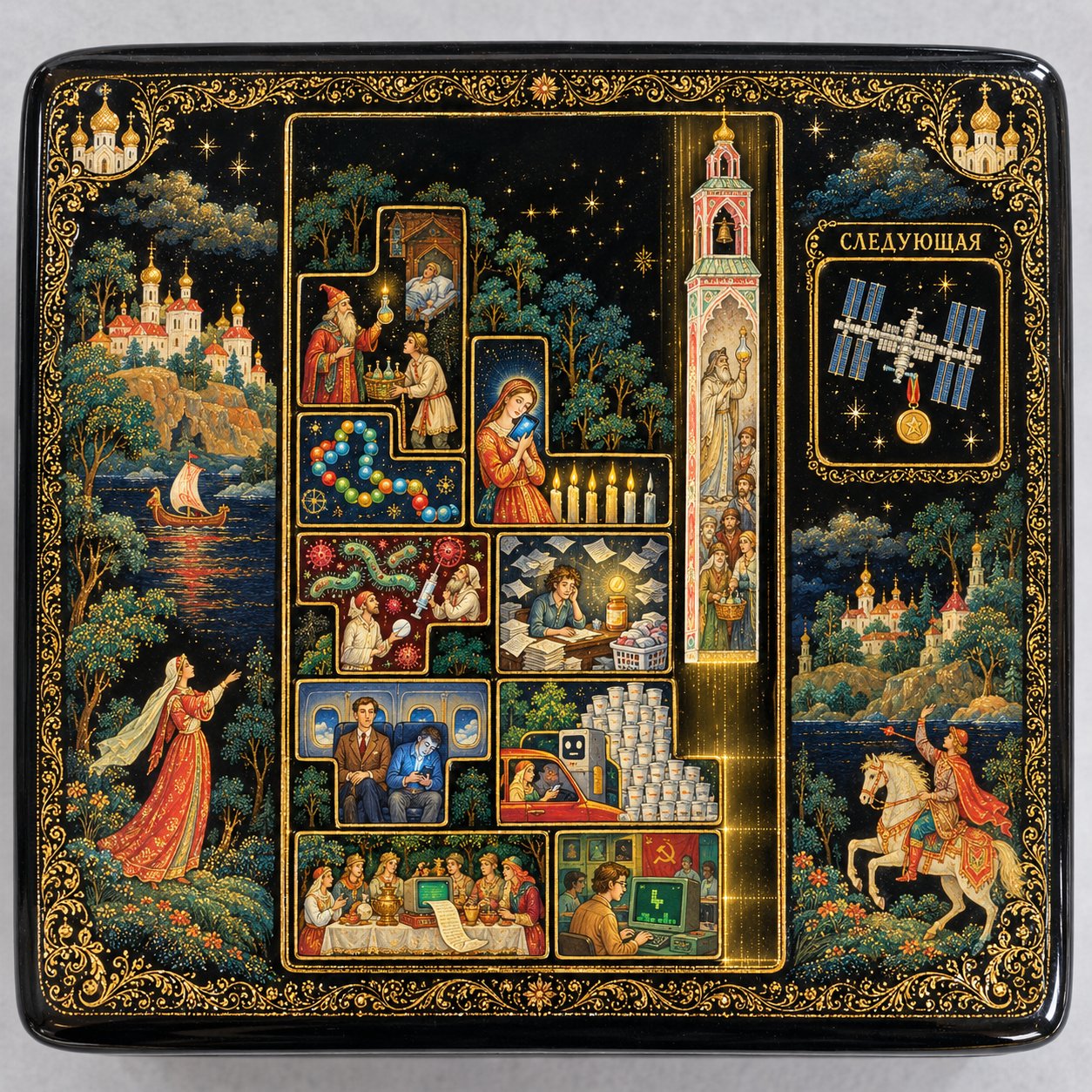
The only model that read the brief all the way down. Real Tetris shapes, the bell tower dropping into the open column, and the only physician who actually holds his flask up to the light. The pisse prophet's patient sits in a separate cell, out of reach. It added a maiden, a horseman and a ship to the border, which is what a Palekh painter would have done.
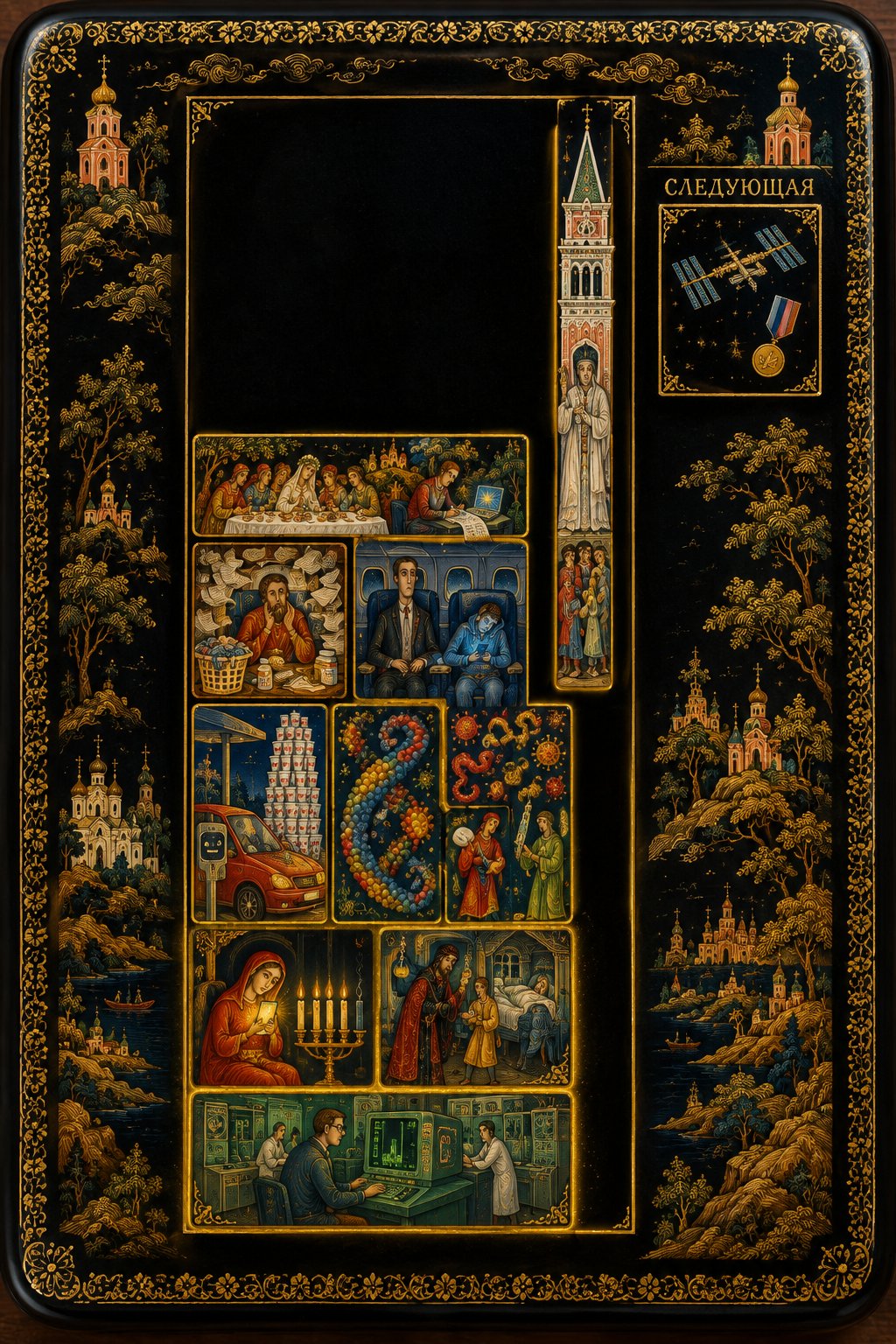
The surprise. Every story is readable, and the airplane row (a suit bolt upright beside a hoodie lit blue by his phone) is the opening exactly. The tower is in the right column, but the pieces are rectangles, the physician just stands there, and the Nobel medal hangs from a Russian tricolor ribbon.
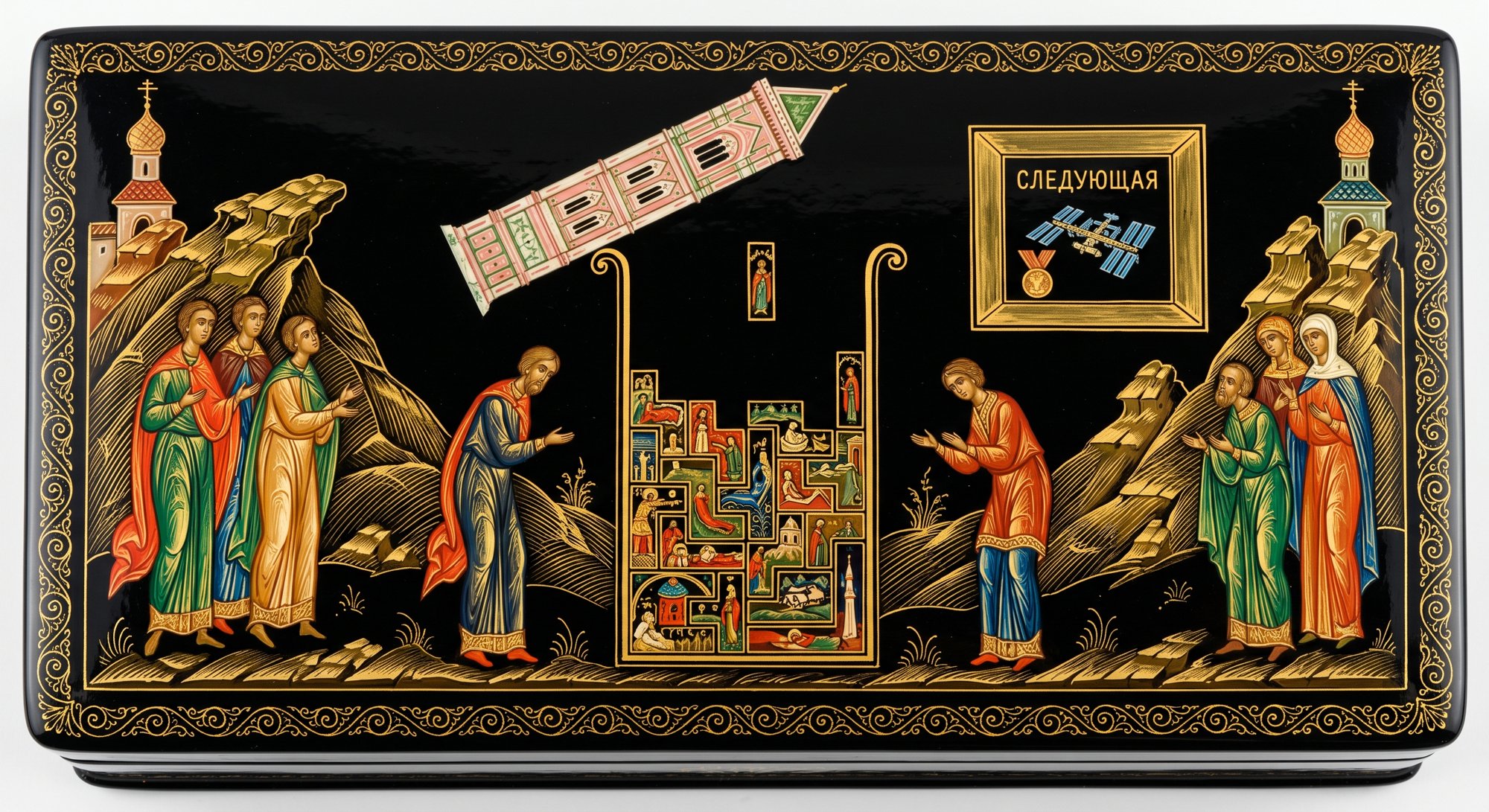
The most convincing lacquer box and the only one where the tower spins as it falls. The pieces are true Tetris shapes and far too small to read. Gemini also added two crowds of apostles on the hillsides, gesturing at the well from a respectful distance. They can't read it either.
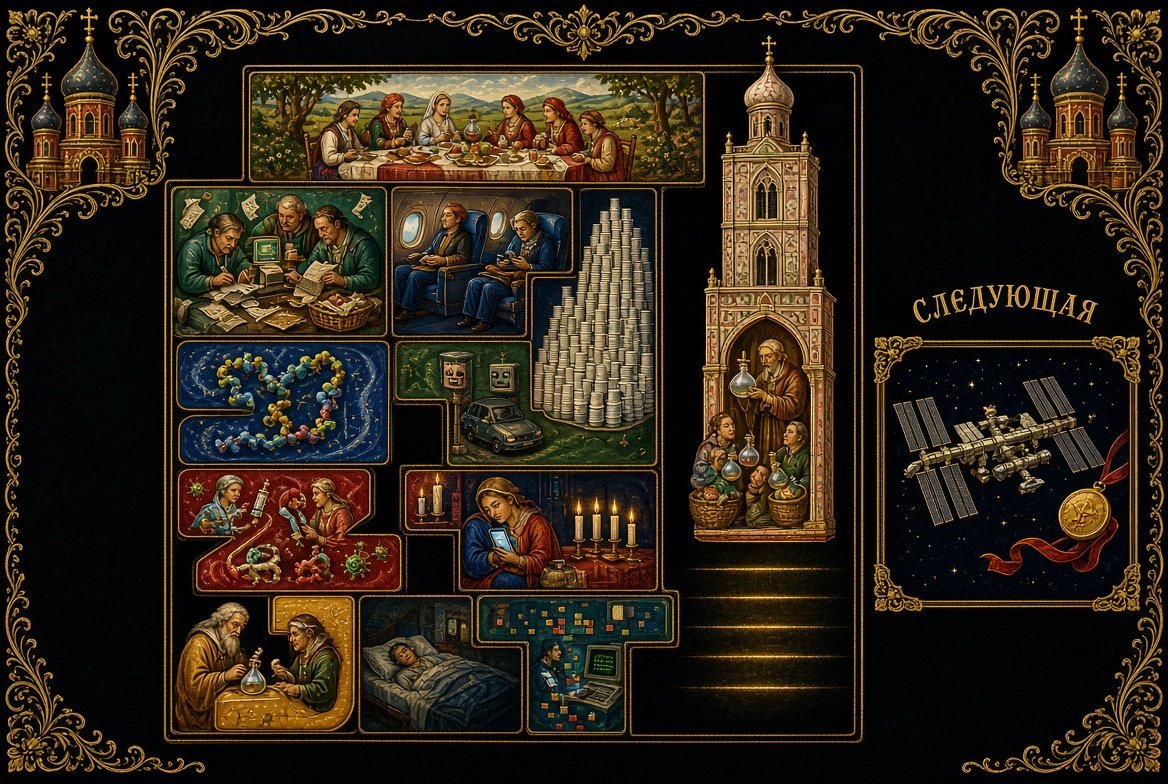
Strong lacquer and gold, and the stories are mostly there. But Grok built an icon wall, not a game board: rectangles in tiers, the tower parked beside them instead of falling. The pisse prophet's patient gets his own panel, which is the distance the joke needs.
Scorecard
| What the prompt asked for | ChatGPT | Perplexity | Gemini | Grok |
|---|---|---|---|---|
| Real Tetris shapes, not rectangles | yes | mostly rectangles | yes | rectangles |
| Each story readable in its piece | yes | yes | too small to read | mostly |
| Long bar falling into the right-hand gap | yes | yes | tilted, above the well | standing beside the stack |
| Physician holds the flask up to the light | yes | no | no physician | holds a flask, not raised |
| Gap left open | yes | yes | yes | yes |
| СЛЕДУЮЩАЯ spelled correctly | yes | yes | yes | yes |
| Pisse prophet's patient kept at a distance | yes | same room | can't tell | own panel |
| Added without being asked | maiden, horseman, ship | village and river border | two crowds of apostles | extra robot post, cup tower |
What we learned
- The tradition beat the game. Grok painted an iconostasis (a wall of stacked icon panels), Gemini staged an adoration scene around the board, and ChatGPT filled the border with fairy-tale riders. Palekh painters spent centuries on icons before the lacquer boxes, and the models seem to know it.
- Only one physician holds the flask to the light. ChatGPT's. The gesture is the whole JERKFoW, and it is the detail three of four dropped.
- The Nobel went Russian. Perplexity hung the medal on a white, blue and red ribbon. ChatGPT gave it a red ribbon and a star, which is closer to a Soviet decoration than to Oslo.
- Nobody filled the gap. I expected at least one model to complete the stack. All four left the right column open.
- The Cyrillic held. Four of four spelled СЛЕДУЮЩАЯ correctly. Text has not been the failure mode for a month.
- Shapes are harder than pictures. Two of four drew rectangles. A Palekh master fits a story to an odd shape; the models would rather choose the frame.
Which piece is which
- Flat barJosh's Wedding: friends at a farm table, a screen writing a poem onto a scroll
- SquareADHD: a man at a desk, laundry basket, a gold coin on a pill bottle
- TThe opening: an airplane row and one armrest
- LArchy: a robot-faced drive-through speaker and 18,000 water cups
- SSynthID Bio: a protein bead chain hiding yellow dots
- ZInfection and cancer: corkscrew bacteria, a syringe and a pill
- LAttachment: a woman, a glowing phone, six candles with the sixth unlit
- JThe pisse prophet: a servant's flask, a patient far away
- TTetris: a 1980s Soviet lab and a green screen
- Falling barUroscopy: Giotto's bell tower and the physician with his flask
- NextThe ISS and a medal (the Peace Prize is announced October 9)
About Palekh, the tower and the game
- Palekh miniatureWikipedia. The craft, its icon-painting roots and its fairy-tale subjects.
- Russian lacquer miniatureUniversity of Kansas, Center for Russian, East European & Eurasian Studies. Why the icon painters switched, and how the boxes are made.
- Casket “Mowing,” I. Markichev, Palekh, 1926State Russian Museum. A real early Palekh box for comparison with the four above.
- Medicine panel, Giotto's bell towerMuseo Galileo. A replica of the 1334 to 1336 relief by Andrea Pisano's workshop: women wait to hand the doctor their urine glasses. The original is in the Museo dell'Opera del Duomo.
- Andrea Pisano, panels from the south side of the bell towerOpera di Santa Maria del Fiore, which holds the originals.
- TetrisWikipedia. Pajitnov, the Dorodnitsyn Computing Centre, and the name (tetra plus tennis).
- The bizarre, murky history of Soviet-born TetrisMIT Press Reader, Julien Mailland. The story this week's Things I Learned is about.
- Who Owns a Falling BlockWAiR analysis of the Mailland excerpt.
The prompt
A Russian Palekh lacquer miniature: egg tempera and shell gold painted on the lid of a black lacquered papier-mâché box, in the manner of the Palekh village masters of the 1930s. Deep glossy black ground. Slender, elongated figures with small heads, drawn with an icon painter's precision; garments and hills hatched with fine gold lines; jewel colors (cinnabar red, emerald, ultramarine, ochre, white) glowing against the black. A border of fine gold scrollwork frames the lid, with two small onion-domed towers at the upper corners.

The picture is a falling-block puzzle game painted as a lacquer miniature. In the center stands a tall, narrow playing well, about twice as tall as it is wide, outlined in gold. The bottom of the well is packed with interlocking four-square pieces in the classic shapes of the game (square, straight bar, T, S, Z, L and J). Each piece is outlined with a thin gold contour, and each piece is painted as ONE miniature scene that fills that piece's whole shape:

1. A straight bar lying flat across the top of the stack: a wedding feast at a long farm table outdoors, old friends leaning toward a small glowing computer screen that is writing a poem onto a paper scroll.
2. A square: a man at a desk, distracted, surrounded by swirling papers and a laundry basket, a small gold coin glowing on top of a pill bottle.
3. A T shape: an airplane cabin row, one passenger sitting stiffly upright beside another who is slumped and lit blue by his phone, their elbows locked on one shared armrest.
4. An L shape: a drive-through lane, a car stopped at a small speaker post that has a simple robot face, a tower of thousands of paper water cups behind it.
5. An S shape: a twisting protein drawn as a chain of colored beads, with a faint hidden pattern of tiny yellow dots.
6. A Z shape: corkscrew-shaped stomach bacteria and small round viruses, one healer holding a vaccine syringe and another holding a pill.
7. A second L shape: a woman embracing a glowing phone, six candles beside her, five lit and the sixth unlit.
8. A J shape: a robed charlatan studying a flask of urine brought to him by a servant, while the sick patient lies in bed in a distant house.
9. A second T shape: a 1980s Soviet computer laboratory, a programmer at a green-screen terminal on which small blocks are falling.

The stack fills the bottom four rows completely EXCEPT for one empty column, one block wide, running down the right-hand edge of the well.

Above that gap, falling into it, is a long straight bar standing upright: painted as a tall Italian Gothic bell tower in pink, white and green marble, with a carved relief on its side of a medieval physician in a long robe holding a glass flask of urine up to the light, while patients wait below holding their flasks in small woven baskets. The four full rows beneath it glow faintly gold, about to clear.

To the right of the well, a small gold-framed window with the Cyrillic word СЛЕДУЮЩАЯ above it shows the next piece: the International Space Station floating against a starry black sky, a gold medal on a ribbon drifting beside it.

Negative: no pixel art, no 8-bit graphics, no beveled plastic blocks, no video game screen, console or controller, no game logo or title, no brand logos, no English text, no photorealism, no 3D render, no flat vector illustration.
First Palekh entry in the feature's history. All past galleries and analyses: wair.ajwein.com