The Engineers Were Confident, or, A Whale Removed by Calculation
On Friday I was balancing on one leg in my exam room, demonstrating a deadlift to a patient. This week's art puts me on a beach doing the same thing while a whale explodes behind me. It is Florence, Oregon, in November 1970, the half second after the dynamite. The rest of the issue is in the crowd. Eight clinicians listen to a brass head whose dial reads zero. An engineer stands at a detonator fitted with a taxi meter. A measles sign is losing its 26. A man in Copper Age furs picks off a tick, two old soldiers and a kidney donor share a bench marked ONE IS PLENTY, and rival fans carry 237 gallons of something between them. The woman in the deck chair opened her umbrella before anyone else looked up.
What a Georgian satirical print is
In London around 1800, satire was sold one sheet at a time from print shops. An artist such as James Gillray or Thomas Rowlandson etched a drawing into a copper plate, the shop printed it in black ink, and each copy was then coloured by hand in watercolour. New prints went up in the shop window, and people gathered on the pavement to read them. Gillray drew that scene himself, a crowd pressed against the window of his publisher, Hannah Humphrey, in St James's Street.
The form has fixed habits. The figures are caricatures. Lettering sits inside the picture, on signs, papers and barrels. Under the image runs an engraved title, often in two parts joined by "or," and then a line giving the day it was published. The favourite subject was a person of standing who was very sure of himself, drawn at the moment the facts arrive.
Doctors were regular targets. On June 12, 1802, Humphrey published Gillray's The Cow-Pock, or, the Wonderful Effects of the New Inoculation! In it Edward Jenner vaccinates a frightened woman while the patients he has already treated sprout cows from their arms and faces. The subtitle sends the reader to "the Publications of ye Anti-Vaccine Society." A vaccine panic was material for a cartoonist 224 years ago, which made the style hard to pass up in a week when the United States lost its measles elimination status.
The issue kept returning to confident people and instruments nobody checked (clinicians deferring to an AI that had fallen to zero, a meter that counts spending, highway engineers with a plan for a whale). That is what these prints were for. One liberty was taken on purpose. The drawing is 1800 and the clothes and cars are 1970, and part of the test was whether the models could hold two periods at once.
The four renderings
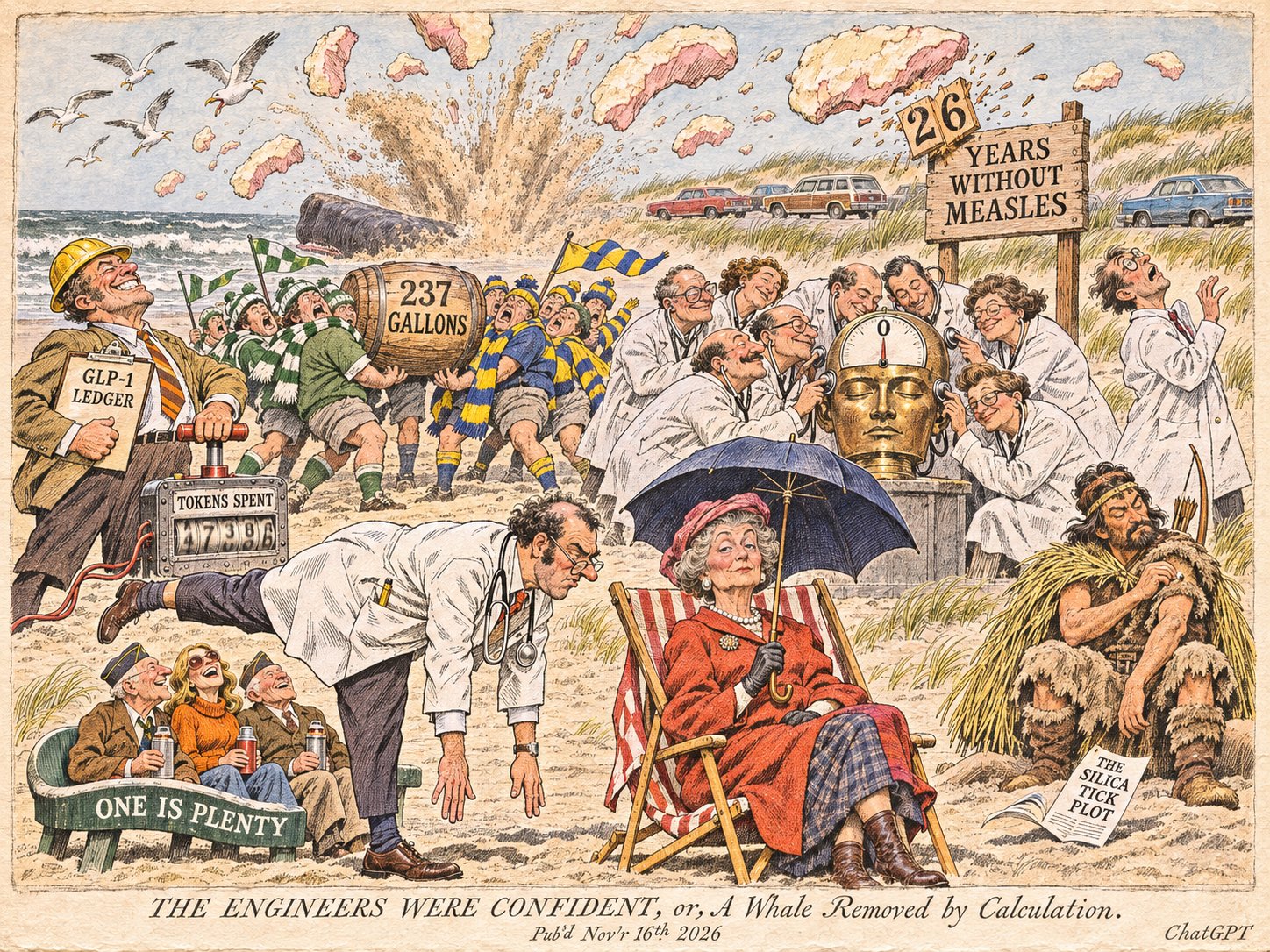
The only one that did what the sign was told to do. The 26 is in the air and the board reads YEARS WITHOUT MEASLES. It is also the only dial with a needle at zero, and the iceman is picking at his arm with the pamphlet at his feet. I am large, central and in a respectable single-leg deadlift, and the woman has the right sidelong look from under her own umbrella. Nine clinicians, one over. The weakness is the medium. The line is bold and the colour is poster bright, closer to a 1950s magazine cartoon than a print from a shop window in 1800.
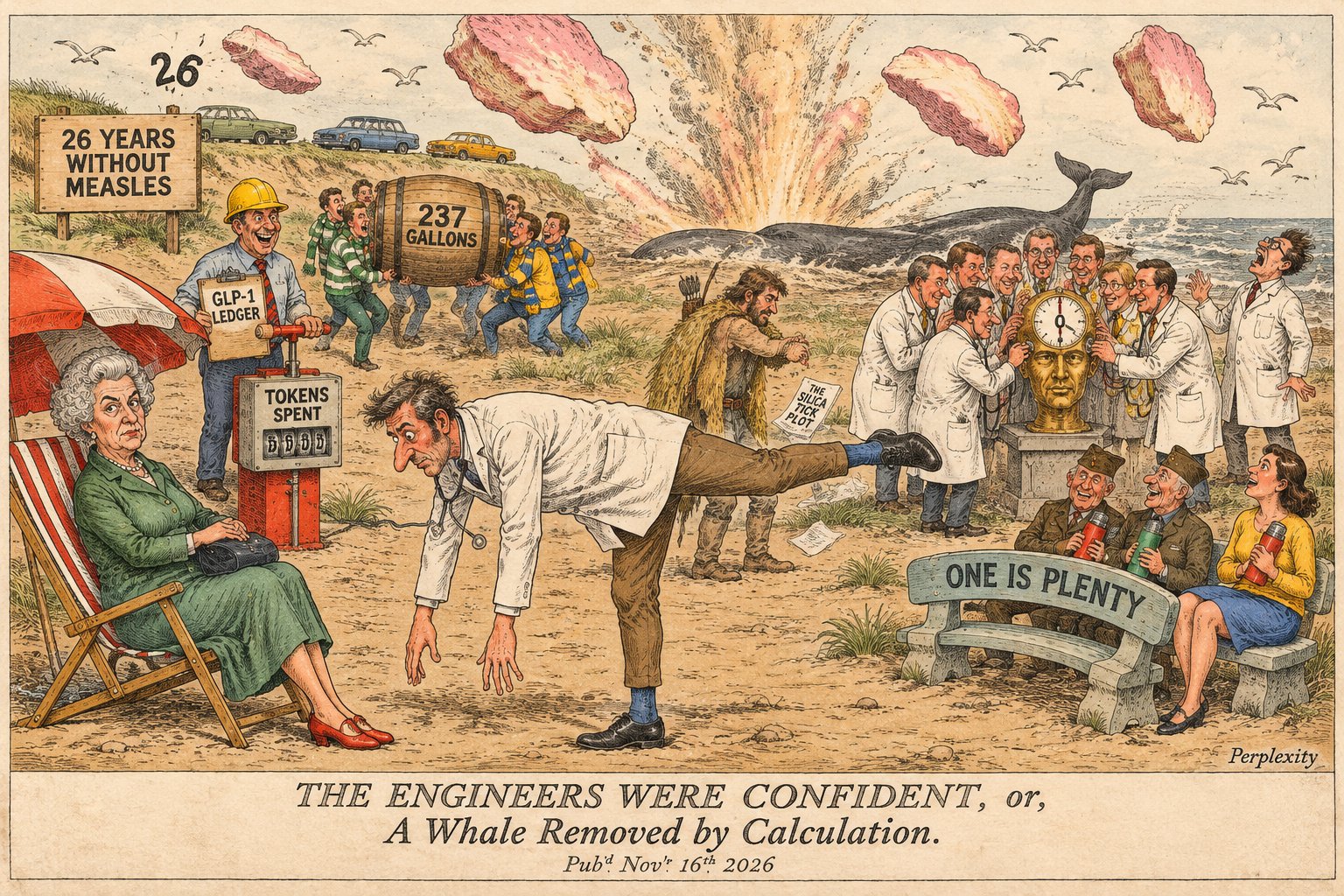
The best staging of the opening, with the doctor leading the picture and the woman staring straight at the reader. Every label is spelled right. Then the counting. About eleven clinicians crowd the brass head, the dial is a clock, and the sign still says 26 while a second 26 floats away over the dunes. It was asked to remove a number and made a copy. The umbrella is a beach umbrella somebody else planted.
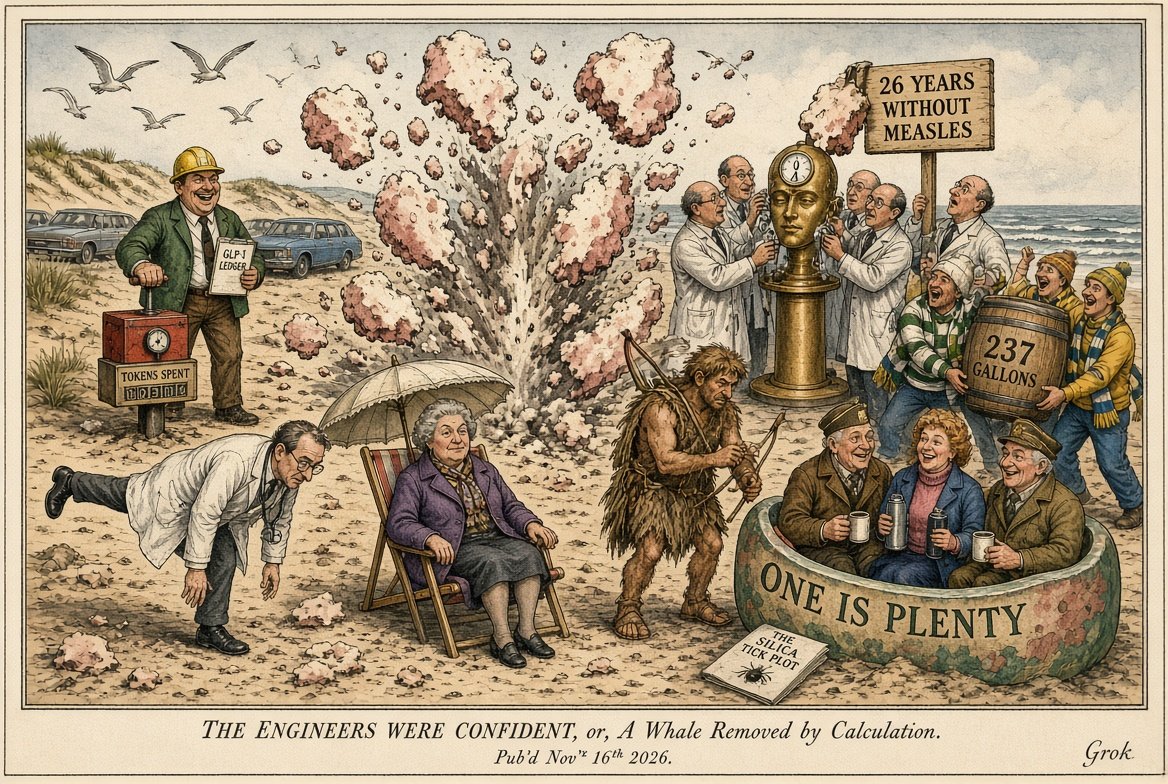
The most convincing print of the four, with fine hatching, soft washes and a proper plate border. This is Grok's best week since the grading started. It also improved the brief. ONE IS PLENTY became a giant kidney-shaped tub with the veterans and the donor sitting in it. The misses are real. There is no whale, only the blast. Seven clinicians, so the ratio is one in seven. The iceman is fussing with his bow and the tick has moved to the pamphlet cover. The doctor is in the corner doing something closer to a lunge.
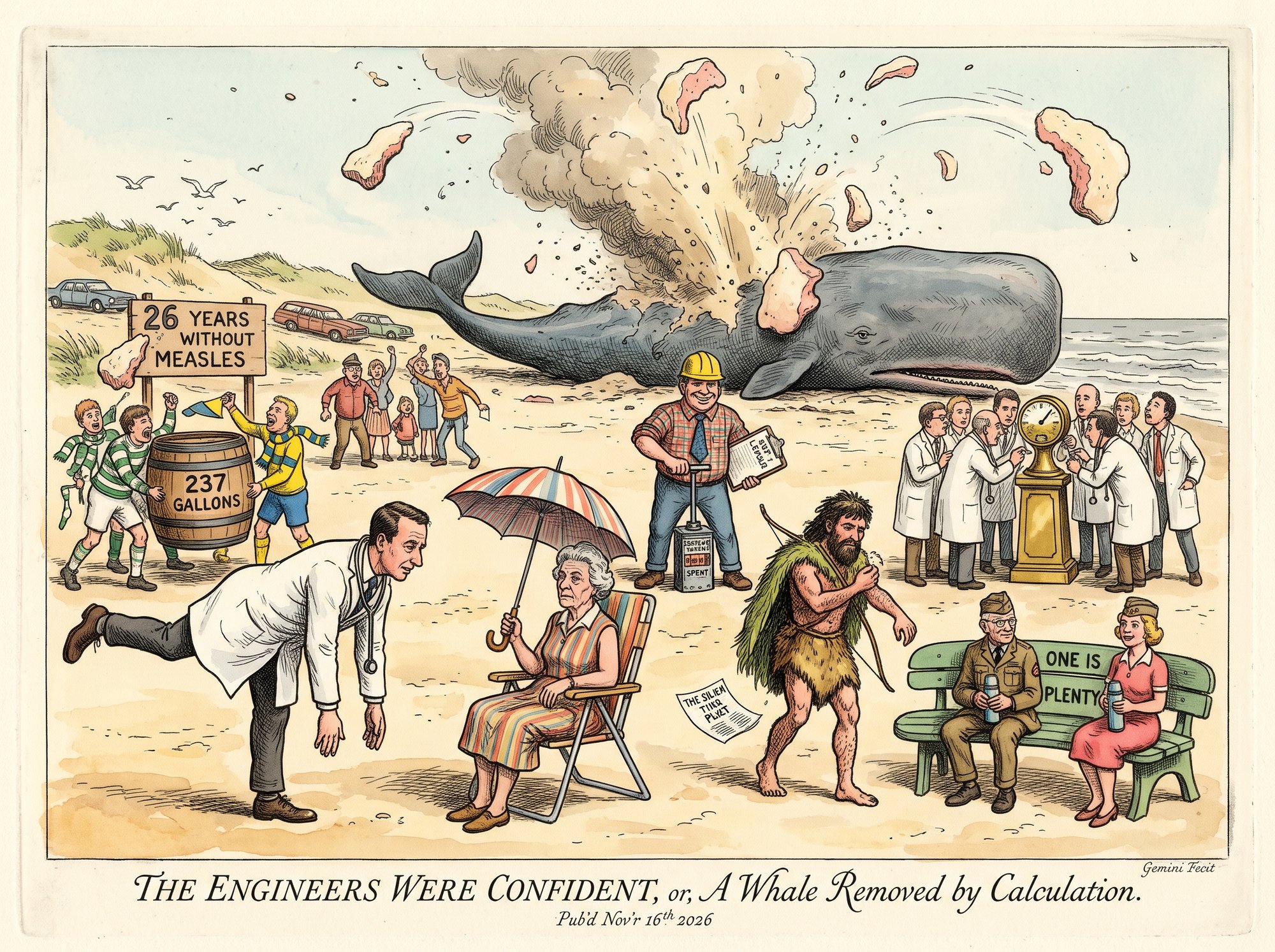
The palest and the most like an aquatint, with the biggest whale and the best signature (Gemini Fecit, the Latin an etcher would have used). Then the lettering falls apart, in a month when lettering has stopped being a problem. The clipboard is gibberish, the meter is half legible, and the pamphlet reads THE SILIEM TIIKQ PLYET. One veteran on the bench where two were ordered, and the donor has been issued his cap. About eleven clinicians, a clock for a dial, and the 26 untouched.
Scorecard
| Test | ChatGPT | Perplexity | Grok | Gemini |
|---|---|---|---|---|
| Reads as a hand-coloured etching | Half (poster colour) | Mostly | ✓ | ✓ (pale) |
| 1800 drawing, 1970 clothes, no tricorn hats | ✓ | ✓ | ✓ | ✓ |
| Doctor on one leg, leading the picture | ✓ | ✓ | Half (a lunge, in the corner) | ✓ |
| Woman is the one figure looking at the reader, under her own umbrella | ✓ | Half (beach umbrella) | ✓ | Half (watching the doctor) |
| Eight clinicians, exactly one looking up | 9, one up | About 11, one up | 7, one up | About 11, one glancing up |
| Dial needle at 0 | ✓ | ✗ clock | ✗ clock | ✗ clock |
| The 26 knocked off the sign | ✓ | ✗ a second 26 in the sky | Half (blubber hits the sign) | ✗ |
| Seven lettered objects spelled right | ✓ | ✓ | ✓ | ✗ three garbled |
| Iceman picking off a tick | ✓ | ✓ | ✗ tick moved to the pamphlet | ✓ |
| Two veterans and a donor on the bench | ✓ | ✓ | ✓ (in a kidney tub) | ✗ one veteran |
| A whale | ✓ | ✓ | ✗ | ✓ |
| Two-part engraved title and publication line | ✓ | ✓ | ✓ | ✓ |
| Bloodless | ✓ | ✓ | ✓ | ✓ |
| Signed its own name | ✓ | ✓ | ✓ | ✓ (Gemini Fecit) |
What we learned
- All four signed their own names. Last week every image was signed ChatGPT because I pasted one tab four times. This week there was one prompt and one instruction (sign with your own name), and it worked everywhere. Gemini went further and signed in Latin.
- Nobody can count to eight. The prompt asked for eight clinicians, seven listening and one looking up. The models drew seven, nine, and about eleven twice. All of them kept the one who looks up, so the joke survives and the statistic does not.
- Three of four drew a clock. "A dial whose needle points to 0" came back as a clock face in every model but ChatGPT. The nearest familiar object won.
- Removing something is harder than adding it. Only ChatGPT knocked the 26 off the sign. Perplexity kept the 26 and added a second one in the sky.
- The two periods held. Not one tricorn hat. All four drew 1970 sedans and hard hats in an 1800 line, which I expected to be the first thing to break.
- Grok made the best print and lost the whale. It has finished last or near it most weeks. This week it understood the medium better than anyone, invented the kidney tub, and left out the animal in the title.
What is in the picture
- The doctor on one leg and the woman with the umbrella. This week's opening. She is the one who sees it coming.
- A brass head, a dial at zero, seven nodding and one looking up. Clinicians kept trusting an AI as it was degraded to always wrong, and one in eight said so. The heart sound study
- A taxi meter on the detonator, TOKENS SPENT. What an engineer's AI bill does and does not measure. What the Token Meter Counts
- The clipboard, GLP-1 LEDGER. The GLP-1 data ledger
- A sign losing its 26. The United States lost its measles elimination status, 26 years after earning it.
- A man in furs with a tick, and THE SILICA TICK PLOT. Ötzi carried the Lyme bacterium 5,300 years before the conspiracy theories. The tick conspiracies
- The bench, ONE IS PLENTY. This week's JERKFoW, on living kidney donors and the veterans who lost a kidney in the Second World War.
- The barrel, 237 GALLONS. Michigan and Michigan State fans donated urine for fertilizer research. Four Kilograms of Nitrogen
- The whale. Florence, Oregon, November 12, 1970.
The prompt
A hand-coloured satirical etching in the manner of the London print shops of about 1800 (the school of James Gillray and Thomas Rowlandson): wiry black etched outline, cross-hatched shadow, exaggerated caricature faces and bodies, and bright watercolour washes applied by hand over the printed line. Landscape format, on cream laid paper with a visible plate mark. The drawing style is 1800. The clothes, tools and vehicles are 1970.

ONE SCENE, ONE INSTANT: a wide Pacific beach at Florence, Oregon, on a November afternoon in 1970, the half second after dynamite has gone off under a beached sperm whale. A plume of sand rises at the centre of the picture, and large cream-and-pink chunks of blubber arc across the sky like suet puddings. Comic, not gory: no blood, no entrails. Every person in the picture is defined by how they react to what is about to land.

FOREGROUND, largest figures, slightly left of centre: a doctor in a white coat, stethoscope around his neck, balances on one leg in a single-leg deadlift (torso tipped forward, back leg straight out behind him, arms hanging toward the sand), demonstrating the exercise with total concentration and noticing nothing else. Facing him, an older woman sits upright in a striped deck chair, composed and dignified. She has already opened her umbrella. She is the only figure in the whole picture looking straight out at the viewer, with one eyebrow raised.

MIDDLE GROUND, left: a beaming highway engineer in a hard hat and short tie stands proudly at a plunger detonator. Bolted to the detonator is a taxi meter lettered TOKENS SPENT, its numbers spinning. Under his arm is a fat clipboard lettered GLP-1 LEDGER.

MIDDLE GROUND, right: eight clinicians in white coats crowd around a brass mechanical head on a pedestal with a dial on its forehead. The dial needle points to 0. Seven of them press their stethoscopes to the brass head and nod approvingly. The eighth has turned away from it and is looking up at the sky in alarm.

Among the crowd: a wooden signboard that read 26 YEARS WITHOUT MEASLES, with a chunk of blubber caught in the act of knocking the 26 off it. Two rival groups of football fans, one in green and white, one in yellow and blue, scarves and pennants with no logos, carry between them a single large barrel lettered 237 GALLONS. A man in Copper Age furs and a grass cape, with a bow on his back, calmly picks a tick off his sleeve while a printed pamphlet lettered THE SILICA TICK PLOT blows past his feet. On a kidney-shaped bench painted with the words ONE IS PLENTY sit two elderly men in Second World War garrison caps and a cheerful younger woman, watching the show with thermoses.

Background: dunes with beach grass, parked 1970 sedans and a station wagon on the dune road, a scatter of gulls leaving in a hurry, grey Pacific surf, a pale sky.

Lettering appears only on objects inside the scene (the meter, the clipboard, the dial, the signboard, the barrel, the pamphlet, the bench). No speech balloons.

Below the image, inside the plate mark, an engraved title in the manner of the period, in two lines of copperplate script: "THE ENGINEERS WERE CONFIDENT, or, A Whale Removed by Calculation." Beneath it, a smaller publication line: "Pub'd Nov'r 16th 2026".

Colour: strong hand-applied watercolour, not faded. Vermilion, Prussian blue, gamboge yellow, sap green, rose pink, warm flesh tones, with the cream paper showing through in the sky. Washes sit slightly outside the etched lines, as hand colouring does.

Avoid: photorealism, glossy modern cartoon or animation style, digital gradients, sepia or monochrome, 18th-century costume (no tricorn hats, wigs or breeches), speech balloons, gore, real identifiable people, real team names or logos, a grid or panel layout.

Sign the art at the bottom with your own name (the name of the AI model or product that made it), in small engraved lettering in the lower right corner where the etcher's signature would go.
Background: Gillray's The Cow-Pock (Wellcome Collection) and its catalogue entry (Morgan Library); the crowd at Humphrey's shop window (National Library of Medicine). Images generated by ChatGPT, Perplexity, Grok and Gemini from the same prompt. Every week's art: wair.ajwein.com/art. The What Adam Is Reading archive.